
How to Choose Water Treatment That Works for Your Whole Home
Water has a way of becoming invisible in our daily lives. We use it when we wake up, brush our teeth, make coffee, take a shower, cook dinner, and wash the dishes. It is everywhere, yet most of us don’t think about its quality until something seems off.
Maybe the water tastes different. Perhaps there’s a faint smell from the kitchen faucet. You start seeing white scale around fixtures, or a glass of water isn’t quite as clear as it used to be.
Those little observations are worth paying attention to, but they don’t necessarily tell you exactly what is happening. Water can contain substances that aren’t visible, and a treatment system that solves one problem may do very little for another.
That’s why choosing water treatment is less about finding the “best” filter and more about finding the right solution for your particular water.
Start by Understanding Your Water
Before shopping for equipment, take a step back.
Where does your water come from? Is it supplied by a municipality or a private well? Have you noticed changes in taste, odor, color, hardness, or pressure?
Testing can provide a much clearer picture.
A basic analysis may examine characteristics such as hardness, pH, iron, manganese, total dissolved solids, and other common water-quality factors. If there’s a specific concern, more targeted testing may be appropriate.
This information gives you something solid to work with. Otherwise, choosing a system can become a guessing game—and nobody wants to spend thousands of dollars guessing.
When Whole-Home Filtration Makes Sense
If the same water-quality issue affects multiple fixtures, treating only the kitchen faucet may not be enough.
whole-home water filtration systems are installed on the incoming water line so treatment can occur before water travels throughout the property.
Depending on the system, whole-home filtration can be used to address concerns such as sediment, certain taste and odor issues, or other identified water-quality characteristics.
Related resource: Making Tap Water More Enjoyable Without Overcomplicating It
There are practical advantages to treating water at the point where it enters the home. Showers, bathroom sinks, laundry, and kitchen fixtures can all receive treated water.
But whole-home filtration isn’t automatically the right answer. If your only concern involves drinking water, a point-of-use system may be simpler and more cost-effective.
Hard Water Requires a Different Approach
Hard water is one of those problems that tends to announce itself slowly.
At first, you may just notice a few spots on the shower glass. Then faucets begin collecting white deposits. Soap doesn’t seem to rinse as easily. Eventually, scale starts becoming a regular cleaning chore.
Hardness is mainly caused by calcium and magnesium.
A water softener is specifically designed to reduce these minerals and can treat water throughout the home. It works differently from a standard filter, which is why simply installing a “stronger” filter isn’t necessarily the answer.
If hardness is the problem, use a technology designed for hardness.
It sounds simple, but that basic principle prevents a lot of unnecessary equipment purchases.
Specialty Filters Have Their Place
Not every water-quality concern fits neatly into a standard filtration category.
Some properties have elevated iron. Others have unusual odors or specific dissolved substances that require targeted treatment.
That’s where specialty water filters can be useful. These systems may use specialized media or filtration methods designed for particular water conditions.
The important thing is to connect the equipment to actual test results.
A specialty filter shouldn’t be selected because it sounds powerful. It should be selected because there’s a specific problem it is capable of addressing.
Related resource: Understanding Iron, Sulfur, and Sediment in Well Water
That distinction can save money and prevent disappointment later.
UV Treatment Works Differently
Ultraviolet treatment is another technology that homeowners may encounter, particularly when microbiological concerns are involved.
uv water disinfection systems use UV light to inactivate certain microorganisms as water passes through a treatment chamber.
Unlike filtration, UV doesn’t physically remove sediment or dissolved minerals. It also doesn’t soften hard water.
That means pretreatment may be necessary. If water is cloudy or contains significant particles, those conditions can interfere with UV performance.
For properties where microbial treatment is appropriate, UV can be a useful part of a broader treatment strategy. It simply needs to be used for the job it’s designed to do.
Don’t Ignore Sediment
Sediment is often more noticeable in some water supplies than others.
Fine particles may settle at the bottom of a glass or collect inside faucet aerators. Larger amounts can clog cartridges and potentially interfere with other treatment equipment.
A properly sized sediment filter can capture particulate matter before it moves farther into the household plumbing.
But don’t automatically choose the finest filter available.
A very fine cartridge may clog quickly if the incoming water contains a lot of sediment. Sometimes staged filtration, with progressively finer treatment, makes more practical sense.
The right setup depends on the quantity and size of particles involved.
Taste and Odor Are Worth Investigating
Water doesn’t have to look dirty to taste unpleasant.
Related resource: Strange Smells and Cloudy Water: What Your Well Might Be Trying to Tell You
Chlorine can influence the taste and smell of municipal water. Iron may create a metallic quality and staining. Certain well-water conditions can produce earthy or sulfur-like odors.
Carbon filtration is often useful for certain taste and odor concerns, but the exact solution depends on what’s causing the issue.
If the water suddenly develops a strong or unusual odor, don’t simply cover it up with a filter. Investigate the cause first.
A treatment system should solve a problem, not just hide the symptom.
Think About Water Pressure
Water treatment equipment needs adequate flow and pressure to operate properly.
This becomes especially important when several people are using water simultaneously.
A system that works perfectly when one faucet is open may struggle when a shower, washing machine, and kitchen sink are operating together.
When choosing equipment, look at peak flow requirements rather than household averages alone.
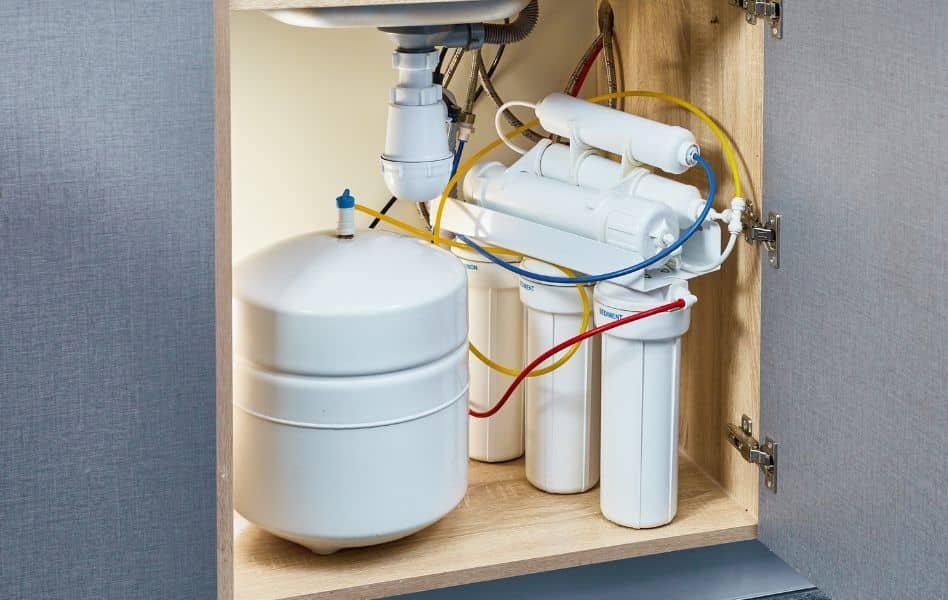
For reverse osmosis systems, pressure is particularly important because the membrane relies on pressure to produce treated water.
If pressure is inadequate, a booster pump may sometimes be considered.
Maintenance Is Part of the Purchase
It’s easy to focus on installation cost and forget about what happens afterward.
Every treatment system has ongoing requirements.
Filters need replacement. UV lamps have service intervals. Softener components may need inspection. Specialized media eventually requires replacement or regeneration.
Related resource: A Closer Look at the Small Details Behind Better Drinking Water
Before purchasing equipment, ask how often maintenance is expected and how much replacement components cost.
A system that looks inexpensive on day one may be more expensive over several years if it requires frequent, costly maintenance.
Think in terms of ownership, not just installation.
Keep the Equipment Accessible
This is a surprisingly important detail.
Don’t install treatment equipment somewhere that makes basic maintenance difficult.
Filters need to be removed. Valves need to be reached. Connections need to be inspected.
If equipment is buried behind storage boxes or squeezed into an inaccessible corner, even simple maintenance becomes a chore.
And when maintenance becomes a chore, people tend to postpone it.
Leave enough working space around the system from the beginning.
Avoid Buying More Than You Need
More equipment doesn’t automatically mean better water.
A homeowner might install several different treatment stages simply because each one sounds useful. But unnecessary equipment increases installation cost, maintenance requirements, and potential points of failure.
Every component should have a reason for being there.
If your water test doesn’t show a particular issue, you may not need a system designed to treat it.
Related resource: What Your Drinking Water Is Telling You About Its Quality
Good water treatment is targeted. It’s not a competition to see how many filters can fit in a utility room.
Consider the Long-Term Picture
The right treatment system should work well today and remain manageable years from now.
Think about replacement parts, service availability, water usage, electricity requirements where applicable, and expected equipment life.
If you’re considering a major installation, ask what happens if a component fails. Can it be repaired easily? Are replacement parts readily available? Will the system continue to work if one filter is overdue?
These aren’t glamorous questions, but they’re practical ones.
Better Water Starts With Better Decisions
There is no single water treatment system that is perfect for every household.
Some homes need whole-home filtration. Others need a softener. Some benefit from point-of-use reverse osmosis, while properties with specific water-quality concerns may require specialty filtration or UV treatment.
The important thing is to avoid treating water based on assumptions.
Test first. Understand the problem. Choose technology that addresses it. Size the equipment properly and plan for maintenance.
Once the right system is in place, you may hardly think about it.
And honestly, that’s a sign of success.
The best water treatment equipment doesn’t demand attention every day. It quietly does its job while you make coffee, take a shower, cook dinner, and fill a glass at the kitchen sink—exactly as it should.
Related Posts
Making Tap Water More Enjoyable Without Overcomplicating It
There’s a particular kind of disappointment that comes from filling a glass of water at home and realizing it doesn’t taste quite…
Open resource →
Understanding Iron, Sulfur, and Sediment in Well Water
There’s a funny thing about water: the more ordinary it looks, the less we tend to question it. Fill a glass, hold…
Open resource →
Strange Smells and Cloudy Water: What Your Well Might Be Trying to Tell You
The first time you notice something strange about your water, it’s usually a small moment. You turn on the kitchen faucet and…
Open resource →