
How Commercial Water Filtration Supports Cleaner, More Reliable Business Operations
Water is one of those business essentials that rarely gets the attention it deserves. People notice electricity bills, internet outages, equipment repairs, and staffing issues. Water? It usually stays in the background.
Until something goes wrong.
A strange taste can affect beverages. Mineral buildup can interfere with equipment. Sediment can clog components. Poorly maintained water systems may create unnecessary operational headaches. In businesses where water is part of everyday service, even a small issue can become surprisingly inconvenient.
The good news is that commercial water treatment doesn’t have to be complicated. The smartest systems usually begin with a simple idea: understand the water, understand how the business uses it, and then select treatment that fits those needs.
Start With the Water Source
Before choosing equipment, it’s worth finding out what you’re actually dealing with.
Municipal water has already been treated, but its characteristics can still vary by location and distribution system. Private wells have their own considerations, including naturally occurring minerals, sediment, and changing groundwater conditions.
Water testing can help identify characteristics such as hardness, pH, iron, manganese, sediment, dissolved solids, and other factors depending on the analysis.
That information matters because treatment technology isn’t interchangeable. A system designed for hardness isn’t necessarily the right answer for sediment or taste.
In other words, don’t buy the solution before understanding the problem.
Commercial Reverse Osmosis Has a Specific Role
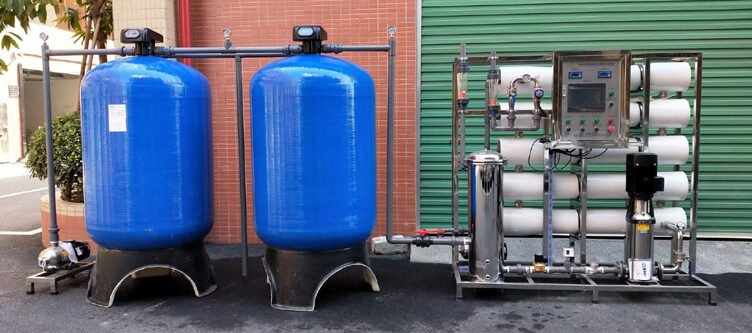
Businesses that need highly treated water for drinking, food preparation, beverage production, or specialized equipment may consider commercial reverse osmosis filtration.
Reverse osmosis uses pressure to move water through a semipermeable membrane. The membrane allows water to pass while reducing many dissolved substances and other contaminants.
Commercial systems are designed for greater demand than typical residential units, but capacity still matters. A restaurant serving hundreds of drinks a day has different requirements from a small office break room.
Related resource: Making Tap Water More Enjoyable Without Overcomplicating It
When considering reverse osmosis, look at production rate, incoming water pressure, pretreatment requirements, storage capacity, wastewater production, and filter replacement schedules.
The membrane is important, but the system around it matters just as much.
Pretreatment Can Protect the Main System
Reverse osmosis membranes don’t exist in a vacuum.
Sediment, chlorine, hardness, and other water characteristics can affect membrane performance depending on the system and water source. Pretreatment may therefore be used to reduce certain stresses before water reaches the membrane.
A sediment filter can capture particles. Carbon filtration may address chlorine and certain tastes or odors. Softening may be considered where hardness is a concern.
The exact combination should be based on the incoming water and equipment specifications rather than a generic checklist.
Sanitation Is About More Than Filtration
Filtration and sanitation aren’t the same thing.
A filter can reduce certain physical or dissolved substances, depending on its design. Sanitation focuses on controlling microorganisms and maintaining hygienic conditions within the appropriate system.
For businesses where water hygiene is particularly important, commercial water sanitization can be an important part of the overall treatment strategy.
The method used depends on the application. Ultraviolet systems, chemical disinfection, heat, and other approaches may be appropriate in different circumstances.
A qualified professional can help determine what method fits the water source, equipment, and operating environment.
Food and Beverage Businesses Have Extra Considerations
Restaurants, cafés, hotels, bakeries, bars, and food-service operations can be especially sensitive to water quality.
Water goes into coffee, tea, ice, soups, sauces, cleaning processes, and countless other daily tasks. A subtle difference in water quality can sometimes affect the final product.
Related resource: Understanding Iron, Sulfur, and Sediment in Well Water
Coffee equipment is a good example.
Mineral content can influence both taste and equipment condition. Too much hardness may contribute to scale, while other characteristics may affect flavor.
The right treatment approach can help create more predictable conditions, which is valuable when customers expect the same drink to taste the same every time.
Ice Deserves More Attention Than It Gets
Ice is often treated as if it’s simply frozen water.
From a quality perspective, though, the water going into an ice machine matters.
Minerals, sediment, and certain tastes or odors can affect the ice produced. Sediment may also interfere with equipment components or filters.
That’s where commercial ice machine filtration becomes relevant for businesses that depend heavily on ice.
Restaurants, hotels, convenience stores, healthcare facilities, and beverage operations may all have different filtration requirements. The filter needs to handle the expected flow and volume while fitting the specific ice-machine manufacturer’s requirements.
It’s a small part of the operation, perhaps, but ice touches the customer’s experience directly.
Don’t Forget Water Pressure
Commercial treatment equipment has to work with the building’s plumbing.
Pressure that’s too low can affect certain systems. Filters can become restrictive as they collect material. Peak demand can create conditions that aren’t obvious during a quiet part of the day.
Imagine testing a treatment system at 9 a.m. when almost nobody is using water, then discovering at lunchtime that several fixtures and machines running together cause a major pressure drop.
That’s why peak flow should be considered during system planning.
Related resource: Strange Smells and Cloudy Water: What Your Well Might Be Trying to Tell You
Maintenance Is an Operational Issue
At home, forgetting a filter replacement is annoying.
At a business, it can become a disruption.
Commercial systems often process much more water than residential equipment, so components may reach their service limits sooner. Filters, membranes, valves, pumps, and other components all have maintenance requirements.
A preventive maintenance schedule helps keep these tasks visible.
Record when filters are replaced. Monitor system performance. Check for leaks. Watch for changes in pressure or water quality.
It’s far easier to plan a service visit than to deal with an unexpected failure during a busy business day.
System Capacity Should Match Real Demand
One of the easiest mistakes is choosing equipment based on average water use alone.
Average demand doesn’t tell the whole story.
A restaurant may have relatively quiet mornings and extremely busy evenings. A hotel can experience large fluctuations depending on occupancy. A manufacturing facility may have processes that require substantial water volumes at particular times.
System sizing should account for these patterns.
Oversizing can increase upfront and operating costs, while undersizing can create performance problems. The sweet spot is equipment that can comfortably handle expected demand without unnecessary excess capacity.
Installation Location Matters
Commercial water treatment systems can occupy considerable space.
Related resource: A Closer Look at the Small Details Behind Better Drinking Water
Tanks, filters, pumps, storage vessels, valves, and related equipment all need room. More importantly, technicians need access to service them.
A system shouldn’t be squeezed into a space simply because it happens to be empty.
Think about filter changes, inspections, drainage, electrical access, and future repairs before installation.
A few extra minutes of planning can prevent years of awkward maintenance.
Consider the Cost of Ownership
The purchase price tells only part of the story.
Businesses should consider filter and membrane replacement, salt if softening is involved, electricity, wastewater, service visits, and eventual equipment replacement.
For high-volume applications, even small differences in operating efficiency can add up.
Ask providers for realistic maintenance expectations rather than focusing exclusively on the initial quote.
A system that’s inexpensive to purchase but expensive to maintain may not be the bargain it first appears to be.
Employee Training Helps Too
Even a well-designed system benefits from basic staff awareness.
Employees don’t need to become water-treatment experts. They should simply know where the equipment is, what normal operation looks like, and who to contact when something seems unusual.
A leaking connection shouldn’t be ignored because everyone assumes someone else will handle it.
Likewise, an unusual taste or sudden pressure change should be reported rather than dismissed.
Related resource: What Your Drinking Water Is Telling You About Its Quality
Small observations can catch problems early.
Don’t Install More Technology Than You Need
Commercial water treatment can become unnecessarily complicated when every possible technology gets added to the system.
More equipment means more filters, more maintenance, more replacement parts, and more opportunities for something to go wrong.
Targeted treatment is generally more sensible.
Test the water. Understand the application. Identify the specific concern. Then select the treatment method that addresses it.
Sometimes that means a sophisticated multi-stage system. Sometimes it means a surprisingly simple filter.
Reliable Water Supports Reliable Operations
Businesses don’t necessarily need to think about water treatment every day.
That’s the beauty of a properly designed system.
When equipment is correctly sized, appropriately installed, routinely maintained, and matched to the water conditions, it can operate quietly in the background.
The best commercial treatment strategy isn’t about having the most filters or the fanciest equipment. It’s about creating predictable water quality where it matters and protecting the systems that depend on it.
Whether the need involves reverse osmosis, sanitation, ice filtration, softening, or a combination of technologies, the same principle applies: start with the facts and build from there.
Water may not be the most glamorous part of running a business, but when it’s reliable, clean, and suited to the job, everything else tends to run a little more smoothly.
Related Posts
Making Tap Water More Enjoyable Without Overcomplicating It
There’s a particular kind of disappointment that comes from filling a glass of water at home and realizing it doesn’t taste quite…
Open resource →
Understanding Iron, Sulfur, and Sediment in Well Water
There’s a funny thing about water: the more ordinary it looks, the less we tend to question it. Fill a glass, hold…
Open resource →
Strange Smells and Cloudy Water: What Your Well Might Be Trying to Tell You
The first time you notice something strange about your water, it’s usually a small moment. You turn on the kitchen faucet and…
Open resource →